
Solving problems before they become much larger.
Solving problems before they become much larger.
Wouldn’t it be nice if we could solve all of our workplace problems before they occur? Short of a crystal ball, this seems impossible.
In the modern business world change is happening at an ever-increasing pace, and the ability to react and adapt appropriately to new situations is crucial for success. Problem solving can be less painful in collaborative working environments, and removing the silos that typically divide employees and departments/functions, every member of a company can more easily understand how their work affects others both upstream and downstream within the business (the whole).
This approach is key if you want to avoid problems becoming larger.
Driving efficiency takes us closer to the ideal situation of delivering what the customer wants in a smooth flow of value-adding activities within a predictable lead time by exposing problems and forcing their resolution – but to become a truly efficient company, everyone needs to be a problem solver.
What prevents standard inputs to a standard process?
Variation, variation, variation, variation, variation…
Variation
Where does variation occur?
Why does variation occur?
Can variation be eliminated?
A problem is simply a variation from standard.
What do standards mean for you?
What do you think is the common understanding of the term “standard” in your company?
What standards exist?
What standards are observed?
What standards are broken?
What would be the reaction to the phrase “we need more standardisation”? Why?
The benefits of process standards:
- Leadership focus – maintenance and improvement
- Basis for training
- Basis for audit and diagnosis
- Controls variability
Remember – Today’s standard should be seen as the basis for improvement.
How do we tackle problems?
How do we find root causes?
How do we stop them happening again?
How do we describe a problem?
- Use facts, with real examples and data wherever possible: Speak With Data
- Identify what should happen, and explain the problem in terms of its variation from the “standard”.
- Don’t just write, use drawings, photos or real things such as reject parts to demonstrate the issues.
3 C’s
Applying problem solving to a real problem is the need to go to the workplace and apply concern, cause, countermeasure to achieve the desired result: solution.
Concern: define the problem fully before looking for solutions
Cause: understand the root causes of the problem – use the 5 why’s method
Countermeasure: implement the solution(s) which tackles the root cause(s)
How can you really define a problem?
Use the 5W’s and 2 H’s
What? (How does the problem show itself?)
Who? (Who does it affect?)
Where? (Where is it found?)
When? (At what moment? How often?)
Why? (Why does it happen?)
How much? (What is the effect – time, money…?)
A well-defined problem is already half way to being solved.
Use PDCA and the appropriate Quality Tools (see below).
7 Quality Tools


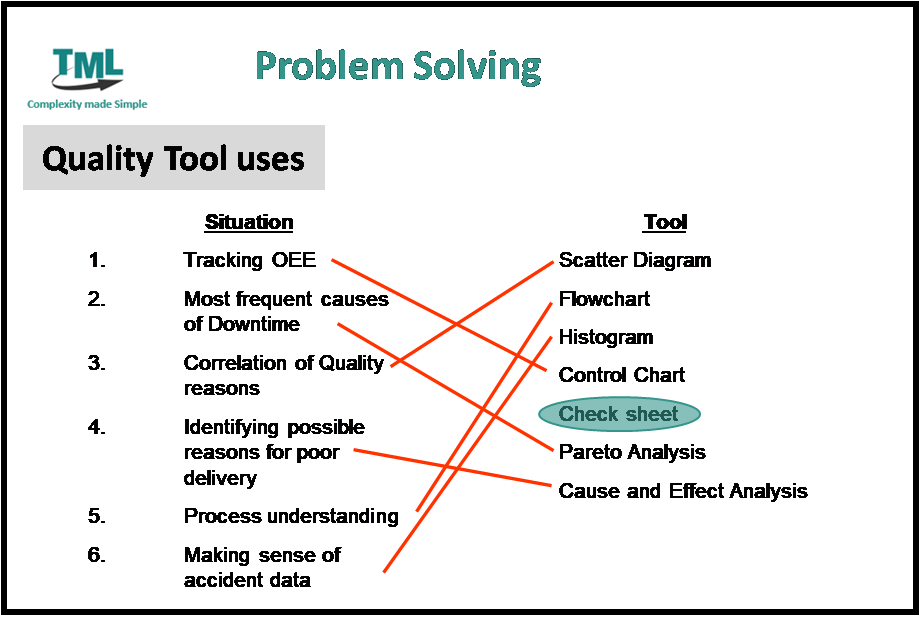
Looking for solutions
It’s not stopping at the first solution and letting everybody contribute their ideas, but not trying to achieve perfection the first time. Making the improvement now even if it’s half of the target enables you to make further improvements later on. PDCA problem-solving board is a good visual to use.
The PDCA cycle is a continuous loop of planning, doing, checking, and acting. It is a simple, effective, and iterative approach for solving problems that allow you and your team to test solutions and assess results in a waste-reducing cycle, helping to drive commitment to continuous improvement, however small, which can improve efficiency and productivity in a controlled way, without the risks of making large scale, untested changes to your processes on a small scale before updating procedures and working practices.
Vague to Exact
PDCA makes it easier to be exact…What, who, by when, why?
Helps outlaw phrases like…should, hopefully, as far as I know, well sort of, thereabouts.
Speaking with data and standards make it easier to be exact.
 Example PDCA started
Routines to adopt support
Every time I’m uncertain >> Do we have a standard?
Every time something’s slower than planned >> Do we use PDCA? What are the facts?
Every time I give/hear a vague reply >> Do we have any data? Am I using the data?
…and then there’s Workplace Organisation.
